
Food Processing Score: Ultra-Processed Food (UPF) Scoring Methodology
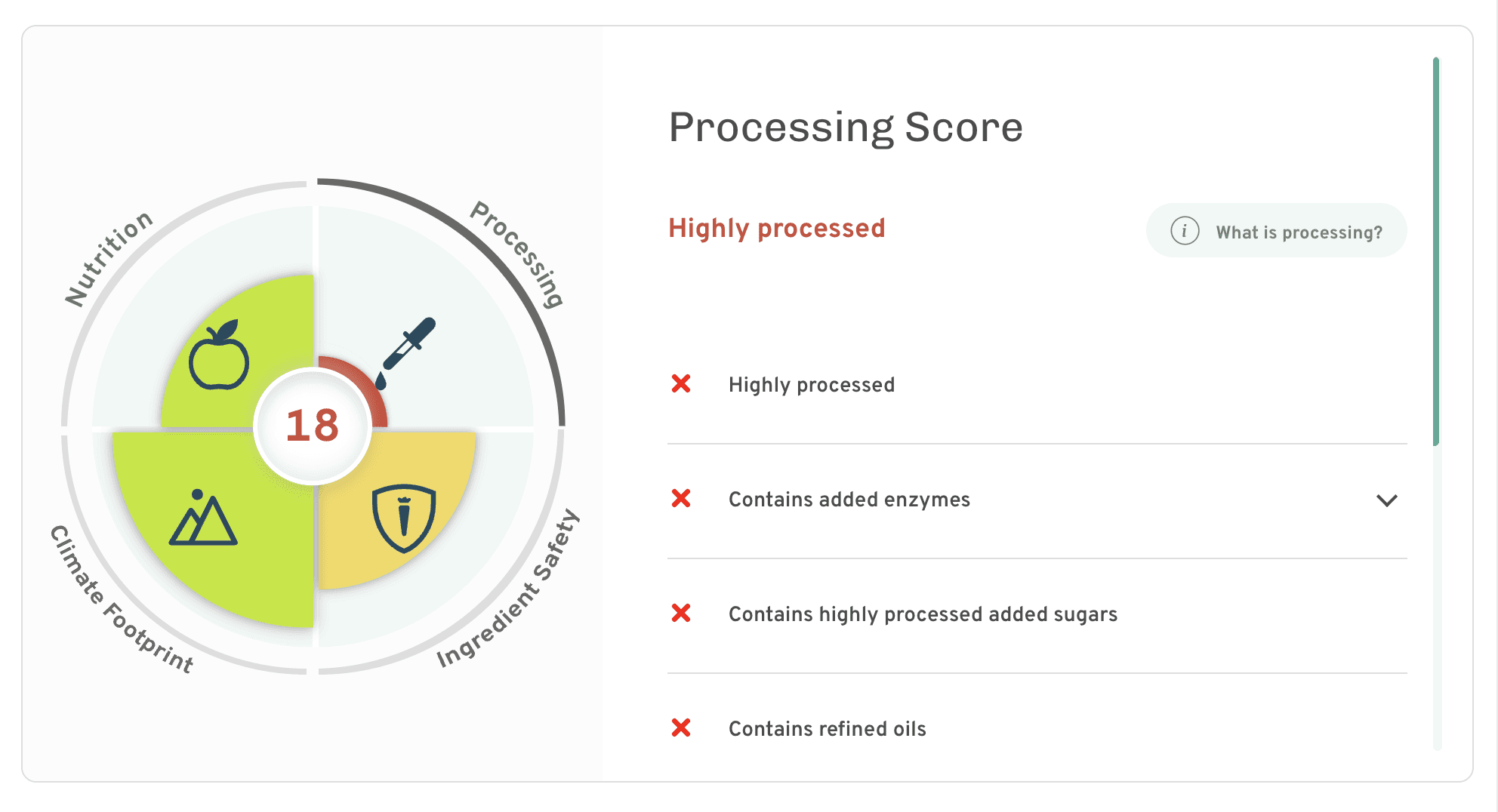
How We Score Ultra-Processed Food
The Food Processing Score evaluates each food based on the degree of processing it has undergone, specifically (i) the processing methods used and their associated health risks and (ii) how prominently processed ingredients appear in the product's formulation. The closer a product is to its natural state, the higher the product will score.
90–100 Unprocessed or minimally processed
50–89 Moderately processed
0–49 Highly processed
The Food Processing Score is one of four science-based food scores that evaluate foods' nutritional density, ingredient processing, ingredient safety, and climate footprint and combine to make the food GreenScore®.
Why Ultra-Processed Food Matters
Ultra-processed foods – which make up over half of the calories consumed by American adults and over 60% for children – pose health risks independent of their nutritional profiles. The only randomized controlled trial on ultra-processed diets found that participants consumed approximately 500 more calories per day on an ultra-processed diet compared to an unprocessed diet, even when both were matched for calories, sugar, fat, fiber, and sodium (Hall et al., Cell Metabolism, 2019). A 2024 umbrella review of approximately 9.9 million participants found associations between ultra-processed food (UPF) consumption and 32 of 45 health outcomes examined, including cardiovascular disease, type 2 diabetes, and all-cause mortality (Lane et al., BMJ, 2024).
Dose-response research shows that each 10% increment in ultra-processed food consumption is associated with a 10% increase in all-cause mortality risk, with no safe threshold identified (Liang et al., Systematic Reviews, 2025).
These findings demonstrate that what has been done to a food matters for health — not just what nutrients it contains. A product can have a favorable nutrient profile while still containing ultra-processing markers associated with adverse health outcomes. The Food Processing Score captures this dimension of food quality that nutrient profiling alone cannot.
How GreenChoice Score's Food Processing
Each food product is evaluated across two dimensions:
(i) How the food has been processed – evaluated across four dimensions of alteration: physical, chemical, thermal, and nutritional. Within these dimensions, the system identifies specific processing categories (over 30 in total) and assigns each a health risk weight based on the strength of peer-reviewed evidence – ranging from minor effects (such as nutrient loss from juicing) to established serious risks (such as IARC-classified carcinogens in processed meat).
(ii) How prominently each processed ingredient appears in the product's formulation. A refined oil listed as the first ingredient has a greater impact on the score than one appearing sixth, reflecting the principle that the ingredients making up the largest share of a product matter most for its processing profile.
The score combines these dimensions using a cumulative model: each detected processing marker reduces the score from its current value, so products with more numerous or more severe markers receive progressively lower scores. This produces a continuous 0–100 score that captures the gradient of ultra-processing – rather than placing products into broad categories where 95% of packaged foods end up in the same tier.
The Four Dimensions of Food Processing
Dimension | What It Captures |
|---|---|
Physical | Structural changes to shape, texture, or appearance — such as milling, extrusion, or homogenization |
Chemical | Addition of chemical compounds, chemical treatment, or formation of new compounds during processing — such as hydrogenation or bleaching |
Thermal | Heating or cooling for preservation, sterility, or structural change — such as pasteurization, frying, or flash-freezing |
Nutritional | Addition or removal of nutrients not inherent to the food's natural state — such as fortification, added sugars, or isolated protein additions |
A process that affects multiple dimensions receives a higher processing impact. For example, frying involves physical, chemical, and thermal alteration, while carbonation involves only physical and chemical changes. This multi-dimensional approach reflects peer-reviewed research showing that the extent of alteration — not just the presence of processing — matters for health outcomes (Fardet et al., Food & Function, 2018; Davidou et al., Food & Function, 2020).
Ultra-Processed Food Categories & Health Evidence
The scoring system classifies over 30 types of processing into evidence-based health risk tiers:
Minor effects – Processes with only minor nutrient loss or negligible health impact. Examples: carbonation (dental erosion risk only), juicing and peeling (some vitamin and fiber loss). These have the smallest impact on a product's score.
Moderate alteration – Processes with moderate effects or mixed evidence. Examples: freezing (minimal nutrient loss; frozen produce is comparable to fresh for most vitamins), fermentation (associated with both gastric cancer risk and microbiome benefits), canning (BPA exposure concerns following EFSA's 20,000-fold reduction in tolerable daily intake in 2023), and fortification (synthetic vitamins may differ in bioavailability from naturally occurring forms).
Additive and compositional concerns – Processes and ingredients with documented health concerns from peer-reviewed research. Examples: food additives such as emulsifiers (linked to gut inflammation and reduced microbiome diversity in human trials), refined grains (associated with increased metabolic syndrome risk compared to whole grains), refined oils (trans fats associated with increased cardiovascular disease mortality), and high-temperature cooking methods like smoking and grilling (formation of compounds classified as carcinogenic by IARC).
Established serious risks – The highest-severity tier, anchored by international health classifications and regulatory actions against ultra-processed food ingredients. Examples: processed meat (classified as a Group 1 carcinogen by IARC — the same category as tobacco smoking – with an 18% increase in colorectal cancer risk per 50g/day), artificial sweeteners (WHO issued a 2023 conditional recommendation against their use for weight control), and artificial colors (EU-mandated warning labels based on a randomized controlled trial demonstrating behavioral effects in children).
Food Processing Levels & Score Ranges
The list of examples in the table below is not all-encompassing and is for example purposes only.
The level of processing depends on the actual processing methods and ingredients used – not the food type. The same category of food can span the entire scoring range. For example, cookies in the GreenChoice database range from scores in the mid-80s (simple, whole-ingredient formulations) down to single digits (products with artificial colors, preservatives, and multiple refined ingredients). A product's score is determined by what's in it, not what it's called.
Level of Processing | Description | Examples | Score Range |
|---|---|---|---|
Unprocessed | Foods in their most natural state that have not undergone any processing beyond harvesting, washing, or chopping | Fresh fruits and vegetables, tubers, raw nuts and seeds | 100 |
Minimally processed | Natural foods processed to preserve, store, or make them edible — without adding substances like salt, sugar, oils, or fats | Frozen fruits and vegetables, dried and unsweetened fruits, herbs and spices, roasted nuts and seeds, dried beans and lentils, whole cuts of meat, fish and poultry, certain whole grains and flours | 90–99 |
Moderately processed | Products prepared using culinary ingredients such as oils, butter, sugar, and salt, or processed using techniques such as extraction, pressing, pasteurization, smoking, curing, pickling, and canning | Pasteurized milks and yogurts, vegetable oils, canned fruits and vegetables, milks and yogurts with added sugar, dried and cured meats, canned fish, freshly made breads and cheeses | 50–89 |
Highly processed (ultra-processed) | Products that contain industrial processing techniques and ingredients used almost solely for industrial use — such as artificial sweeteners, colors, emulsifiers, thickening agents, and other additives | Soft drinks, candies, pre-packaged snacks such as crackers and cookies, mass-produced breads, pre-prepared and ready-to-eat or ready-to-heat meals | 0–49 |
Why Continuous Scoring Outperforms Categorical Classification
Most food processing classification systems place products into broad categories — often resulting in over 95% of packaged foods landing in the same "ultra-processed" tier with no further differentiation. This makes it nearly impossible to distinguish between a fortified whole-grain cereal and a candy bar.
The Food Processing Score addresses this limitation with a continuous 0–100 scale. Two products both classified as "moderately processed" may have meaningfully different scores — a score of 85 versus a score of 55 reflects a real difference in processing intensity. This enables consumers, retailers, and dietitians to compare products within the same tier, a capability that categorical systems do not provide.
Peer-reviewed research supports this continuous approach: a machine learning study published in Nature Communications demonstrated that a continuous processing index outperformed categorical classification for predicting metabolic health outcomes including metabolic syndrome, diabetes, and elevated blood pressure (Menichetti et al., 2023).
Data Sources
The Food Processing Score's health risk weights are based on peer-reviewed research. Key references include:
Hall, K.D. et al. "Ultra-processed diets cause excess calorie intake and weight gain." Cell Metabolism, 30(1), 67–77 (2019). https://doi.org/10.1016/j.cmet.2019.05.008
Lane, M.M. et al. "Ultra-processed food exposure and adverse health outcomes." BMJ, 384, e077310 (2024). https://doi.org/10.1136/bmj-2023-077310
Liang, Y. et al. "Ultra-processed food consumption and all-cause mortality: dose-response meta-analysis." Systematic Reviews (2025). https://pubmed.ncbi.nlm.nih.gov/40033461/
Bouvard, V. et al. "Carcinogenicity of consumption of red and processed meat." Lancet Oncology, 16(16), 1599–1600 (2015). https://doi.org/10.1016/S1470-2045(15)00444-1
WHO. "Use of non-sugar sweeteners: WHO guideline." (2023). https://www.who.int/publications/i/item/9789240073616
McCann, D. et al. "Food additives and hyperactive behaviour in 3-year-old and 8/9-year-old children." Lancet, 370, 1560–1567 (2007). https://doi.org/10.1016/S0140-6736(07)61306-3
Chassaing, B. et al. "Randomized controlled-feeding study of dietary emulsifier carboxymethylcellulose reveals detrimental impacts on the gut microbiota and metabolome." Gastroenterology, 162(3), 743–756 (2022). https://doi.org/10.1053/j.gastro.2021.11.006
EFSA. "Re-evaluation of the risks to public health related to the presence of bisphenol A (BPA) in foodstuffs." EFSA Journal, 21(4), e06857 (2023). https://doi.org/10.2903/j.efsa.2023.6857
de Souza, R.J. et al. "Intake of saturated and trans unsaturated fatty acids and risk of all cause mortality, cardiovascular disease, and type 2 diabetes." BMJ, 351, h3978 (2015). https://doi.org/10.1136/bmj.h3978
Menichetti, G. et al. "Machine learning prediction of the degree of food processing." Nature Communications, 14, 2312 (2023). https://doi.org/10.1038/s41467-023-37457-1
Fardet, A. et al. "Characterization of food degree of processing in food studies." Food & Function, 9, 1463–1478 (2018). https://doi.org/10.1039/C7FO01495C
Davidou, S. et al. "A new holistic approach to food processing assessment." Food & Function, 11, 10381–10391 (2020). https://doi.org/10.1039/D0FO01546F
